

Aug 15, 2026 8 min read
How long does a full apartment renovation take in NYC? A data-backed timeline

If you are planning a full apartment renovation in New York City, the first question you should ask is not about cost. It is about time.
Time is the variable that quietly defines almost every other decision in a renovation. It shapes carrying costs, temporary housing, contractor selection, design choices, and the day you actually move in. And yet most homeowners begin a renovation with only a vague sense of how long it will take. They hear “six months” from one contractor and “maybe a year” from another, and they assume the truth is somewhere in the middle.
In our experience, that assumption is usually wrong. The truth is often longer than either estimate, and the reasons have less to do with construction than most people realize. Permits, approvals, procurement lead times, and design revisions can quietly add months that nobody planned for.
This guide breaks down the realistic timeline for a full apartment renovation in NYC, phase by phase, with the time ranges we see most often.
The honest answer: most NYC apartment renovations take up to 77 weeks
A full-scope apartment renovation in New York City - meaning a project that touches kitchens, bathrooms, layouts, electrical, plumbing, and finishes - typically averages 77 weeks from contract signing to move-in. A 1,200-square-foot condo with a flexible board and an experienced team can land near the lower end, while a 3,500-square-foot prewar co-op with structural work and a slow board can easily push past 77 weeks.
At Chapter Renovation , our average across full-scope NYC apartment renovations is 38 weeks from signed contract to project closeout. We track this number internally and publish the methodology on request. The figure is not a marketing claim. It is the median outcome of how we operate — a system designed to compress the timeline at every phase where most projects lose time.
The six phases of a NYC apartment renovation
-
1. Feasibility and scope definition
Typical duration: 3 to 4 weeks.
This is the phase where the homeowner, the design team, and the contractor align on what the project actually is. Square footage, scope of work, structural ambitions, target finish level, and budget range are all defined here. Skipping this phase or rushing through it is the most common reason projects run long later. A clear scope at the beginning means fewer revisions in the middle.
-
2. Design and architectural drawings
Typical duration: 6 to 12 weeks.
Floor plans, elevations, material selections, kitchen and bath layouts, and any structural or systems drawings are produced in this phase. Homeowners who make decisions quickly and trust their design team can complete this phase in six weeks. Homeowners who revise major decisions repeatedly can stretch it to twelve weeks or longer. Every revision loop adds time.
-
3. Building approval and alteration agreement
Typical duration: 4 to 12 weeks for co-ops, 2 to 6 weeks for condos.
Co-op boards and condo management companies review architectural plans, contractor insurance, construction schedules, and the alteration agreement. In a co-op, the board may meet only monthly and may request revisions. This phase frequently runs longer than expected, which is why we treat board approval as a critical-path workstream from day one.
-
4. Department of Buildings filing and permits
Typical duration: 6 to 16 weeks.
Most full-scope NYC renovations require filings with the New York City Department of Buildings. Alteration Type 2 filings are the most common for apartment renovations. Filing time depends on the complexity of the project, the responsiveness of the DOB, and whether an expediter is involved. Projects involving structural work, plumbing modifications, or gas line changes typically take longer.
-
5. Procurement and material lead times
Typical duration: 8 to 20 weeks, running in parallel with other phases.
Custom cabinetry, imported tile, natural stone, and specialty fixtures often have lead times of 12 to 20 weeks. The single most important thing a contractor can do for your timeline is to begin procurement before construction starts, not after. When procurement runs sequentially after construction begins, projects lose months waiting for materials that should have been ordered during the approval phase.
-
6. Construction
Typical duration: 16 to 32 weeks.
Demolition, framing, plumbing rough-in, electrical rough-in, HVAC, drywall, finishes, cabinetry, tile, paint, and final punch list. A 2,000-square-foot full-gut renovation typically takes 20 to 24 weeks of active construction when nothing goes wrong. When materials arrive late or change orders are introduced mid-project, construction can extend significantly.
Co-op vs. condo: the timeline difference
In our experience, the same scope of work in a co-op takes approximately 6 to 10 weeks longer than in a condo. The difference is almost entirely in the approval phase. Co-op boards review more documentation, meet less frequently, and reserve the right to request revisions. Condo associations typically have a faster, more transparent process.
How Chapter Renovation's 38-week average is built
Most contractors run renovations sequentially. One project manager handles every phase: design coordination, board package, DOB filing, procurement, construction, and financials. When that PM is on the phone with the DOB, every other workstream waits.
Chapter Renovation staffs every project with dedicated specialist teams: a DOB and Board Approvals team, an Interior Design team, a Project Management team, a Procurement team, and a Project Financials team. These teams run in parallel. The Board team files while the Design team finalizes selections while the Procurement team locks in material orders. This is the structural reason our timeline is shorter.
Chapter Renovation's Renotech™, our proprietary technology platform, is the operating system that coordinates these teams and streamlines the process for the clients making their decisions easier. Real-time client portal, BIM cost modeling, 3D pre-visualization, on-site video surveillance, digital documentation, and AI-assisted scheduling all reduce the latency between phases.
A real Chapter Renovation example:
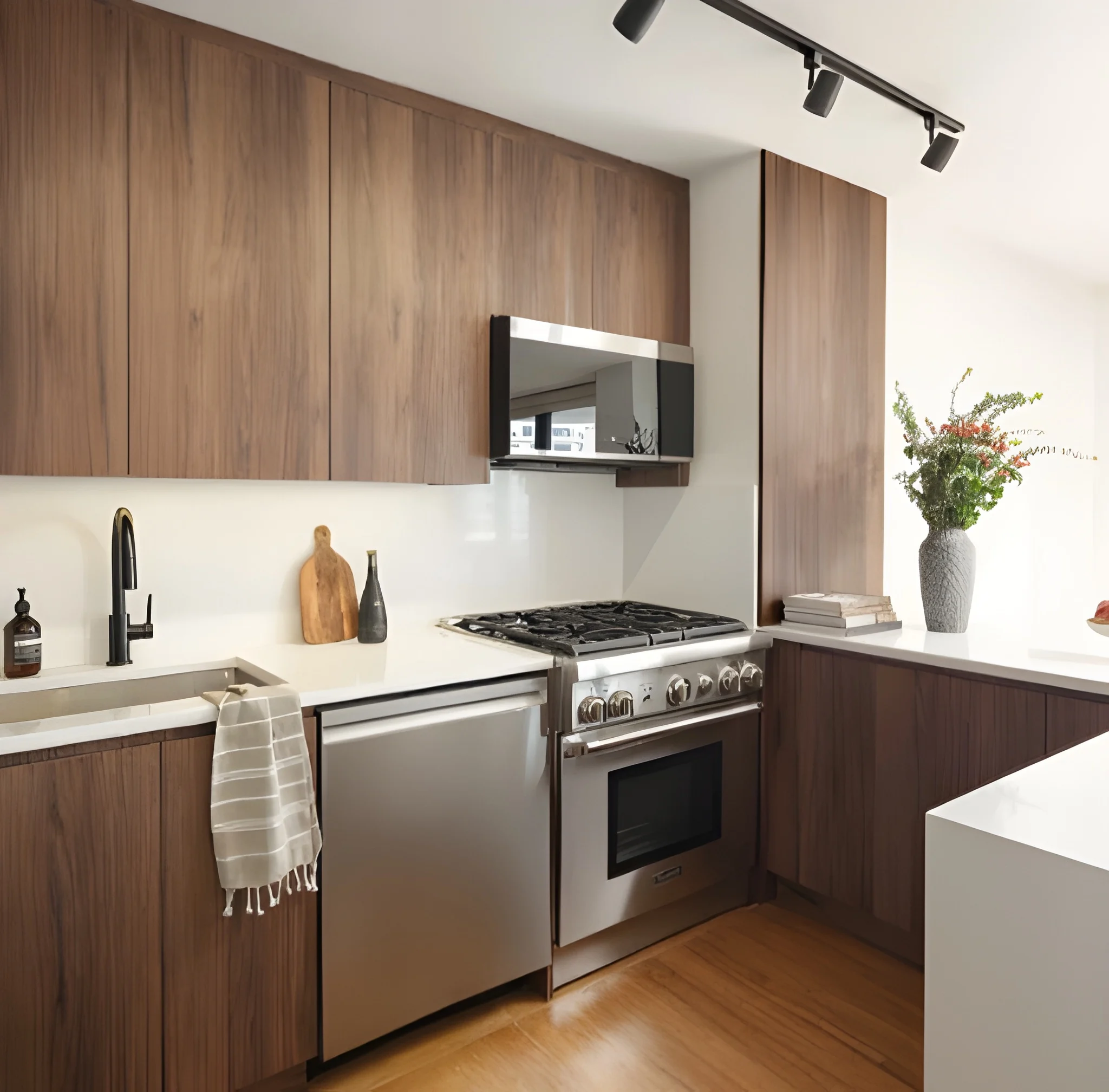
Timelines make more sense when there’s a real project behind them. Take a two-bedroom, two-bath condo at 309 East 49th Street in Midtown East . At 1,244 square feet, the apartment underwent a full renovation that touched every room. The kitchen was completely redesigned with custom dark wood cabinetry, marble countertops, and new finishes. Both bathrooms were renovated, electrical and mechanical work was completed, and the existing layout remained unchanged.
The entire project took approximately 19 weeks.
The biggest difference often comes down to sequencing. In a traditional renovation, design happens first, then procurement, then approvals, then construction. Different teams may be responsible for each stage, and the project can sit still between them. Those gaps add up.
What Chapter Renovation does differently: When the same team manages the process from beginning to end, those phases don’t have to wait for one another. Procurement can begin while design is being finalized. Long-lead materials can be ordered while approvals are underway. Construction can start with key items already in production. Instead of treating the renovation as a series of separate steps, the schedule is built around what can happen at the same time.
The Midtown East project was also managed through Chapter Renovation's Renotech™ client portal, giving the homeowner a clear view of progress, upcoming milestones, and decisions that needed to be made. They didn’t have to wait for a weekly call to understand where the project stood.
That kind of visibility matters more than it might seem. When a homeowner knows a decision is coming, there’s less chance of that decision holding up the next phase. Renovation delays rarely come from one major problem. More often, they build gradually - a selection made a week late, an order placed later than planned, or a handoff that sits untouched for a few days.
A faster renovation isn’t necessarily about moving faster. It’s about leaving less time where nothing is moving at all.
FAQs: NYC Apartment Renovation
How long does it take to renovate Condos & Co-ops in NYC?
Managing strict building Alteration Agreements and rigid "work hours" typically stretches traditional renovations to an industry average of 77 weeks. Chapter Renovation completes these builds in just 38 weeks by handling board approvals and design simultaneously.
How long does the board approval phase actually take?
Co-op board approvals typically take 8 to 16 weeks. Condo approvals typically take 2 to 6 weeks.
Can you start demolition before DOB permits are approved?
No. Demolition that requires DOB permits cannot begin until the permits are issued.
How long does it take to renovate multi-unit combinations NYC?
Merging adjacent or vertical apartments requires complex DOB structural filings that traditional linear teams spend over 18 months (78+ weeks) navigating. By working simultaneously across all design and permitting areas from day one, we bring it down to our 38-week benchmark.
How long does a full home renovation typically take with Chapter Renovation?
We pride ourselves on efficiency without compromising quality. Our current average project duration is 38 weeks from start to finish. By utilizing our proprietary Renotech™ system, we streamline workflows to ensure your home is move-in ready much faster than industry standards
Does the 38-week timeline include the design and permitting phase?
Yes. Our Renotech™ process is designed to fast-track the pre-construction phase, including architectural plans and material sourcing. We hit that 38-week mark by coordinating all logistics and permit filings well before the first hammer swings.
Does Chapter Renovation offer a guaranteed completion date?
We provide a target completion date in our initial proposal and update it at each phase milestone. Individual timelines depend on scope, building approvals, DOB requirements, material selections, and client-driven changes.
Final thoughts
The timeline of a NYC apartment renovation is not a fixed number. It is a series of phases, each with its own range, and the variance between a well-managed project and a poorly-managed one is measured in months. The most reliable way to compress a renovation timeline is not to rush construction - it is to run approvals, design, and procurement in parallel from the start.
Results may vary. Individual timelines depend on scope, building approvals, DOB requirements, material selections, and client-driven changes.
Start your transformation with Chapter Renovation
Talk to our team about your NYC apartment renovation. We will give you a realistic timeline, a clear scope, and a transparent process from day one.